Altogether I really enjoyed this Action Project because of the art element. I love it when I am able to add in my extracurricular interests into my school action projects. The most interesting part of this unit was diving into the human eye. It was cool to me to see the evolution of the human eye and to think about where it will be in another 1000 years.
Showing posts with label STEAM. Show all posts
Showing posts with label STEAM. Show all posts
Sunday, January 26, 2020
Put a Pin in it| A PINteresting Experiment With Pinhole Cameras
Hello and welcome to the first Action Project of my winter term STEAM course, Light, Sound and Time. In this unit, Light, we discussed whether light was a wave or particle, similar triangles, sine, cosine, tangent, and how light equals energy. We tried out a really "sweet" experiment with chocolate to show the concept of light equals energy. Finally, we began work on this action project, which is making a pinhole camera. I was very excited to do this project because one of my interests outside of school is photography, and this is a new type of photography that I have never tried before. In order to develop our photos, we took a Field Experience to Harry S. Truman College where we met with Ignacio Alvarez who took us to the darkroom and taught us how to develop photos. Sadly, my photos did not turn out as expected but, I still learned a lot about film photography and its relation to light.
Altogether I really enjoyed this Action Project because of the art element. I love it when I am able to add in my extracurricular interests into my school action projects. The most interesting part of this unit was diving into the human eye. It was cool to me to see the evolution of the human eye and to think about where it will be in another 1000 years.
Altogether I really enjoyed this Action Project because of the art element. I love it when I am able to add in my extracurricular interests into my school action projects. The most interesting part of this unit was diving into the human eye. It was cool to me to see the evolution of the human eye and to think about where it will be in another 1000 years.
Wednesday, October 2, 2019
Wanna Betta' Shovel?
In my first Action Project for my Junior STEAM class, Design and Engineering, we took a deep dive into empathy. Empathy is understanding and caring about another person's situation. This is an idea that designers use when making objects for consumers to use. This is what we did for this AP. Along with my partner LHM, we designed a shovel that was made to work for senior citizens with empathy in mind. To prepare for designing, I interviewed my mother while gardening to see what tools she likes and which tools she would change. As a class, we went Home Depot to see how consumers buy tools and how businesses accommodate the supply and demand.
Our new tool is a shovel that allows you to get leverage without compromising your balance.
It does this by having a place for your knees to be able to push into the shovel allowing you to dig deeper into hard soil without lifting your feet.
The additional part is the knee rest, this allows for better leverage and greater ability to dig into the soil.
This is an example of innovation and efficiency because the shovel has a new part that allows senior consumers to be comfortable and have the confidence to shovel without losing balance.
These are the ways our tool is better than the competition's:
Our shovel has a sleeker more “modern” look, it allows for better leverage than the average shovel and it allows the older consumer to not be worried they will fall while shoveling.
How? Our shovel uses a lever as a mechanism to access the knee rests. It is a first-class lever because the fulcrum is in between the input and output.
In my opinion, I really enjoyed this project. I liked being able to design and customize a tool that will work for almost every consumer. If I could change anything I would change the way that using the knee rests may ignore a potential consumer that cannot use their knees.
Wednesday, May 1, 2019
Resective Surgery Investigation
Hello and welcome to the first AP of the STEAM course Cure. In this class, we investigated cures to the diseases that we discovered in the last course. We learned about Cells, Mitosis, Miosis, and different math concepts. This AP was very fun to do, I decided to look into a surgery that is in a field I'm interested in Neurology. The surgery we will be investigating in this AP is Resective Surgery. This is a very interesting surgery let's dive deeper.
Friday, March 15, 2019
Excercise in Empathy| Anorexia Nervosa
Hello and welcome to the second AP for my STEAM class Disease. In this unit, we talked about mental diseases and their impact on people. We read the book The Reason I Jump by Naoki Higashida which was written by a 13-year-old on the autism spectrum. Math-wise we discussed piecewise functions and point-slope form. For this AP we were called to make a presentation that would make people empathize with people experiencing a certain mental disorder. For my presentation, I did Anorexia Nervosa.
This AP was very interesting for me. I felt that it was a good experience to learn about anorexia. There are a lot of misrepresentations of anorexia in the media. I did not know a lot about this mental disorder until now. Hopefully, my presentation will help dispel the myths around anorexia.
Works Cited
Three, BBC. “Anorexia Recovery Story: How I Survived An Eating Disorder.” YouTube, YouTube, 1 July 2018,
American Psychiatric Association. (2013). Diagnostic and statistical manual of mental disorders (5th ed.). Arlington, VA: American Psychiatric Publishing.
Thursday, February 14, 2019
Marie | An Exploration and Profile of Breast Cancer
Hello and welcome to my first AP for my STEAM course, Disease. In Disease, we have talked about blood, cancer, and body systems. In a few assignments, we went over cancer and how it affects the body, why it happens and some of the options that people seek to treat it. This AP was very challenging for me. I wanted to create an informative patient profile while also not making it sound cold or impersonal. In this AP, we will be learning about the breast cancer survivor Marie and her experience. We will be going over her surgeries, aftercare, risks, and symptoms.
Marie is a 42-year-old white woman who lives with her husband and foster children in Cleveland. Marie never had any children of her own. When giving herself a breast exam, our patient noticed a lump in her breast and new dimpling. According to Marie, “At first, that didn’t worry me because my mother had a lump in her breast that was benign.” (benign means that it is not cancerous) Four months later, however, Marie noticed a discharge from her nipple. “This is what worried me; that was what wasn’t normal.” Following this, she went to her primary care physician to get a mammogram. A mammogram uses x-rays to examine the breast for lumps. Marie was not very active and had a history of breast cancer in her family; these factors heightened her risk for breast cancer.
After many tests, Marie was referred to get a single mastectomy which is a surgery in which the breast tissue is removed. The skin remained intact, but they were not able to save Marie’s nipple. Before the surgery, Marie prepared by buying a special pillow and special sweatshirts with pockets that hold the drains (tubes connected to pouches that are placed in during surgery to prevent the buildup of fluid.) “I searched frantically for someone to tell me how this was going to go. The doctors gave me medical advice but weren't able to give me first-hand insight.”
Marie’s surgery was life-saving as well as life-changing.“I think, as a woman, so much pressure is put on you to look feminine. I felt almost guilty that I was giving away one of the most feminine aspects of my body.” Marie says that she went through a slight depression over the loss of her breast.
Breast cancer is a disease that affects mostly women ages 40 and up. 12 percent of women (all ages) get breast cancer and 1 percent of men get breast cancer. This disease can affect the breast tissue, lungs, liver, and lymph nodes by spreading into the bloodstream and attacking the cells. Cancer occurs when cells in the body don’t shut off their reproduction function. In the instance of breast cancer, this affects cells in the breast. Symptoms of breast cancer are redness and tenderness of the breast, discharge from the nipple, a newly inverted nipple, and dimpling of the breast.
There are 3 main treatments of all cancers; radiation, chemotherapy, and surgery. The surgeries we discussed earlier are broken down from breast-conserving to complete removal. Complete removal is necessary when the whole breast is affected with cancer and there aren’t just one or two lumps to remove. There are breast-conserving surgeries called lumpectomy (where only the cancerous lump is removed) and partial mastectomy (where part of the breast is removed).
Some risk factors of breast cancer are being overweight, starting your period before the age of 12 or starting menopause after the age of 55 these factors both producing high amounts of estrogen, smoking, alcohol consumption, and not having children before 40. Marie was put at risk because of her family's history with cancer and also some of her lifestyle choices.
Breast cancer has a major impact on the body of the person who affects the disease. Below you will see a diagram of the affected lymph nodes, liver, lungs and breast tissue.

TN Breast Cancer Diagram 2019
Citations
“Breast Cancer Surgery.” American Cancer Society, Feb 13
“CDC - What Are the Risk Factors for Breast Cancer?” Centers for Disease Control and Prevention,
Centers for Disease Control and Prevention,
Centers for Disease Control and Prevention,
“Breast Cancer Foundation.” Susan G. Komen®,
Friday, January 18, 2019
Partners In Time | A History Themed Board Game
Hello all history teachers and buffs welcome to your dreams come true!
What is it you ask? Partners in Time!
Partners in Time is a game where you join Steve Howard and Dino in their adventure from 1880 to 1990. Compete with other players to collect as many artifacts as possible and win. This is a history-themed board game that I made with SR and MT for people who love and teach history. Its fun and exciting while also having educational elements!
Check out the rules below!
This project was really a wild ride! From the start, my team and I knew that we wanted to create a fun, themed game that engaged everyone. The art from the game is inspired by the Steampunk culture and style. We decided with this style because we wanted to stand out from other time travel games. We got the idea for Steve Howard and his dog Dino when we found little figurines in a bag of bottle caps. We decided they would be the perfect characters to follow along in our game. Playtesting the game was one of my favorite parts seeing people excited and having fun while playing the game we worked so hard on really was an amazing feeling!
For Partners In Time, I designed the Artifact cards, the back of the Symbol Cards, the Symbol Dice, and the Masterpiece. I was really pushed to use skills that I knew but hadn't ever used before like, using the laser cutter and 3D printer. I even learned some lettering skills! I am most proud of the art for the cards. I think it looks so smooth and really captures the aesthetic we were going for. I think that I could improve at working in a team. I think that I was really lucky and we had a dream team but, there were times when certain aspects of the game got confused and that was fixed with better communication.
Partners in Time is a game where you join Steve Howard and Dino in their adventure from 1880 to 1990. Compete with other players to collect as many artifacts as possible and win. This is a history-themed board game that I made with SR and MT for people who love and teach history. Its fun and exciting while also having educational elements!
Check out the rules below!
This slideshow has pictures of some of our first prototypes before we finished the game!
This project was really a wild ride! From the start, my team and I knew that we wanted to create a fun, themed game that engaged everyone. The art from the game is inspired by the Steampunk culture and style. We decided with this style because we wanted to stand out from other time travel games. We got the idea for Steve Howard and his dog Dino when we found little figurines in a bag of bottle caps. We decided they would be the perfect characters to follow along in our game. Playtesting the game was one of my favorite parts seeing people excited and having fun while playing the game we worked so hard on really was an amazing feeling!
For Partners In Time, I designed the Artifact cards, the back of the Symbol Cards, the Symbol Dice, and the Masterpiece. I was really pushed to use skills that I knew but hadn't ever used before like, using the laser cutter and 3D printer. I even learned some lettering skills! I am most proud of the art for the cards. I think it looks so smooth and really captures the aesthetic we were going for. I think that I could improve at working in a team. I think that I was really lucky and we had a dream team but, there were times when certain aspects of the game got confused and that was fixed with better communication.
Sunday, October 28, 2018
Ring-tailed lemurs... Again?
Hello and welcome to my final AP for the class Population. In this AP you will be looking at the direct relationship of lemurs and humans. I've created a video to explain this for you.
Citations
World of meters "world population" 2018
Citations
World of meters "world population" 2018
Sunday, October 14, 2018
In the year 2518...( Lemur Edition)
Due to global warming, rainfall in the eastern hemisphere has increased. Most rainforests have completely flooded which has killed most bush bearing fruit. Bad news for the ring-tailed lemur; the only lemur who stays on the ground. Over time the rainforest floor will be completely barren and will not have anything for these lemurs to eat. They will have to learn to climb and fight against other tree-dwelling lemurs (and other) species.
Let's Meet the Lemurs
Now that you have met them, it's time to say good-bye. Only four lemurs have survived and here's why:
Let's Meet the Lemurs
Now that you have met them, it's time to say good-bye. Only four lemurs have survived and here's why:
- George has survived because of his ability to climb trees and cut leaves from those trees with his knife-like nails
- Duke has developed a high pitch scream which scares off the competition
- Nola long fingers, like George which
- Kindi has light yellow eyes which don't reflect light during the night. This allows her to sneak around during the night.
Sunday, September 30, 2018
Clocks|skcolC
 |
| TN "Mirrored Clock" 2018 |
Hello and welcome to my Geometry workshop's first AP. In this class, we discussed mathematic proofs, symmetry, and process of elimination. For this AP, we are going in depth on reflections. As an example our teacher Will took the game pong and traced out where the ball was going. You can find his AP here.
I decided to look for reflections and angles in clocks. Why? Well, angles are the sole focus of wall clocks and if you are looking at a clock in a mirror you will see a completely different time and end up late to your meeting!
In the picture below you will see the angle of the clock measured and reflected with a website called GeoGebra and I will be using slope in order to measure the reflections.
 |
| TN "Angles" 2018 |
Line CF (5,12) (9,11) 11-12/9-5 -1/4 -0.25
Line EF (9,11) (6,6) 11-6/9-6 5/3 1.6
Point slope Form
Line CF Y-12= -0.25(x-5)
Line EG Y-6=1.6(x-6)
In conclusion, mathematically proving that there were reflections in the clock was challenging. As was figuring out the correct math equations to use. This AP was very intriguing and fun to do.
Wednesday, September 19, 2018
Ring my Tail: The taxonomy and life of the ring-tailed Lemur
 |
| Tambako the Jaguar, "Two Lemurs..." 2011 |
The Ring-tailed lemur, also known as Lemur cattus, can be found in the Comoro Islands of Madagascar. The type of habitat ring-tailed lemurs usually live in is a rainforest type environment with plenty of trees. They often live in female-dominated groups of usually around 17 members. The Lemurs lifespan is usually 16- 19 years in the wild. Interestingly, they are the only lemurs that spend most of their time on the ground instead of trees.
Scientists use something called the taxonomic system to categorize different animals. The taxonomy levels are that we talked about in class are.
Kingdom
Phylum
Class
Order
Family
Genus
Species
Here is the Ring-tailed lemur taxonomy
 |
| TN "Taxonomy table" 2018 |
This is a diagram that I made that points out some of the taxonomy levels and how they are categorized.

Here is the reference picture:
 |
| TN JCA LIH "Venn Diagram" 2018 |
This venn diagram compares my ring-tailed lemur with my partners' (JCA and LIH) black bear and red panda. It was very difficult to find similarities between the black bear and lemur because it seems like they were total opposites! However, we ended up finding common ground with night vision.
Below I've described the ring-tailed lemur using set theory statements;
Ring-tailed lemur ∈ Primates
Ring-tailed lemur is the set of Primates
Ring-tailed lemur ∉ Carnivores
Ring-tailed lemur is not the set of Carnivores
Monkeys ⊆ Primates
The set of Monkeys is a subset of Primates
Ring-tailed lemur ~Nocturnal
Ring-tailed lemur is an element of Nocturnal'
Ring-tailed lemur ∈ Vegetarian
Ring-tailed lemur is an element of Vegetarian
All in all, I really enjoyed this project it challenged me to draw which I almost never do! I really understood set theory and was able to do this AP pretty easily. I think this AP was a great way to start the new school year!
Citations
Ring tailed lemur. PA Smith Animal fact guide
Monday, June 4, 2018
Bready or not
Hello! Welcome to Food Unit 2 AP. In this unit, we discussed leavening agents, why 350 is the perfect temperature for cookies and for this Action project we baked our own bread. Why did we do this? To see the differences between bread recipes that used two different leaving agents Yeast ( Control) and Baking soda (experimental).
In the end, I was able to really see the differences in loaves of bread. Which is something I never really considered when buying or eating bread. Who knew so much science was in food!
In the end, I was able to really see the differences in loaves of bread. Which is something I never really considered when buying or eating bread. Who knew so much science was in food!
Friday, March 23, 2018
Get Woke! (about your CO2 consumption)
This is the last AP for Fuel. In this unit, Future, we discussed chemical equations, pollution, reviewed graphing inequalities. We had an AP guest, Christa Markgraff from Nicor gas, we reviewed everything we learned this term and competed to win candies and bragging rights. This AP is to wake readers up and have them realize how much CO2 we are actually emitting and how we are throwing off the
carbon cycle.
As we are getting closer to the end of the year I think it is important to have projects where we are promoting a cause and introducing readers to a call to action. This AP was challenging yet, fun to complete especially because it's in a different format than I am used to.
carbon cycle.
As we are getting closer to the end of the year I think it is important to have projects where we are promoting a cause and introducing readers to a call to action. This AP was challenging yet, fun to complete especially because it's in a different format than I am used to.
Thursday, March 8, 2018
Solar express
In this unit of Fuel, we dove deeper into renewable resources like Solar power, wind power, and hydropower. We went on an FE to ComEd where we reviewed things like how electricity gets to your home. In this action project, I made an infomercial convincing you to invest in solar power. Have you ever wondered about the amazing power of solar power!? If you have continue watching!
In conclusion, This unit of fuel was extremely productive I learned a lot about how I can clean the world and More!
In conclusion, This unit of fuel was extremely productive I learned a lot about how I can clean the world and More!
Thursday, February 15, 2018
What the Frack!?
Hello! Welcome to my first winter term AP in the STEAM course Fuel! In this unit we talked about different ways different types of fuels fuel the world around us. We went to a Tesla showroom and learned about how electricity is transformed into fuel for the 100% electric cars. In this Action project I'm going to be selling you on Natural Gas and telling you why I think you should invest in it.
Thursday, December 14, 2017
Carve On!
In this unit of Rapid Prototyping, 2.5D, we went over density, mass,and volume calculations. We also learned about the Carvey, a CNC machine that we have at GCE. For this action project we went over our school's core values, AAPGA. I made a handmade and Carvey- made plaque regarding Achievement one of the core valuse that sticks the most out for me. This project showed me all the diffrent options that we have for making different projects!
Thursday, November 30, 2017
Cut it
For our Steam class Rapid Prototyping We learned about CNC machines Our First action project in this class looked at man vs machine. We looked at the SDGs to use as a poster and we made handmade as well as cameo cutter designs to compare the two.
If I could do this project over I would use my time better. The hardest part of this project was the handmade version. It took alot of time to cut out each of the letters.
Wednesday, October 11, 2017
FIL(ter) ME UP, BUTTERCUP
In H20 we started a new unit called, 4.5 billion in which we went on a Field Experience to the Jardine Water Filtration Plant where we saw water being filtered at a huge scale. In class we discussed the water cycle and groundwater filtration. The information that I collected from the water plant and groundwater filtration really helped me perfect my AP.
In my water filter I used:
First, I Cut the water bottle in half so that I could use the bottom as the collecting cup and the top as the filter next I wrap the filter around the mouth of the bottle, next I added in the piece of aquarium core then a layer of charcoal then a layer of sand, charcoal, and sand, and then gravel to top it off
My filter will work because the water goes through areas with very small pores multiple times leaving behind any particles in the layer above. At the bottom of the filter the water goes through a coffee filter which covers the mouth of the water bottle.
My filter is similar to groundwater filtration because it includes Gravel and Sand as filter layers.
I chose to use charcoal because at the water plant I learned that activated charcoal and activated carbon can help better the taste of water. I chose to use the bottom of the bottle as a cup because during a water crisis I'm sure that I would want to keep things as minimal as possible.

My hypothesis is that the color of the water will change and the particles will be filtered out.
The source of the water is from the bathroom sink in school, plus some dirt from the garden outside. The pH level before was 5.4 and after was 6.7.
Description and pH of the water
In my water filter I used:
- Water bottle
- 1 coffee filter
- a rubber band
- gravel
- sand
- powdered charcoal
- a small piece of aquarium filter core
First, I Cut the water bottle in half so that I could use the bottom as the collecting cup and the top as the filter next I wrap the filter around the mouth of the bottle, next I added in the piece of aquarium core then a layer of charcoal then a layer of sand, charcoal, and sand, and then gravel to top it off
My filter will work because the water goes through areas with very small pores multiple times leaving behind any particles in the layer above. At the bottom of the filter the water goes through a coffee filter which covers the mouth of the water bottle.
My filter is similar to groundwater filtration because it includes Gravel and Sand as filter layers.
I chose to use charcoal because at the water plant I learned that activated charcoal and activated carbon can help better the taste of water. I chose to use the bottom of the bottle as a cup because during a water crisis I'm sure that I would want to keep things as minimal as possible.
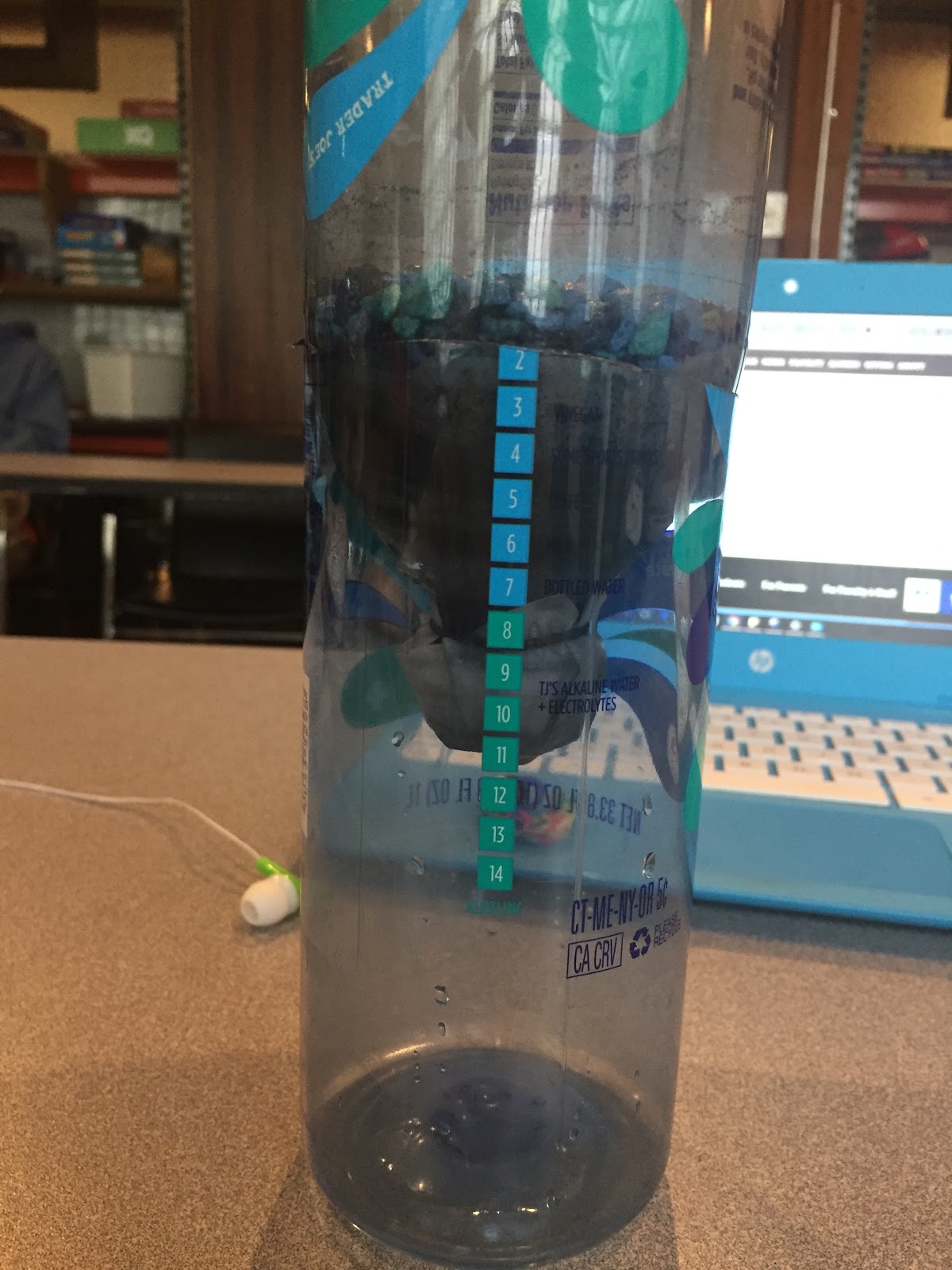 |
| TN (2017) My finished water filter |
The source of the water is from the bathroom sink in school, plus some dirt from the garden outside. The pH level before was 5.4 and after was 6.7.
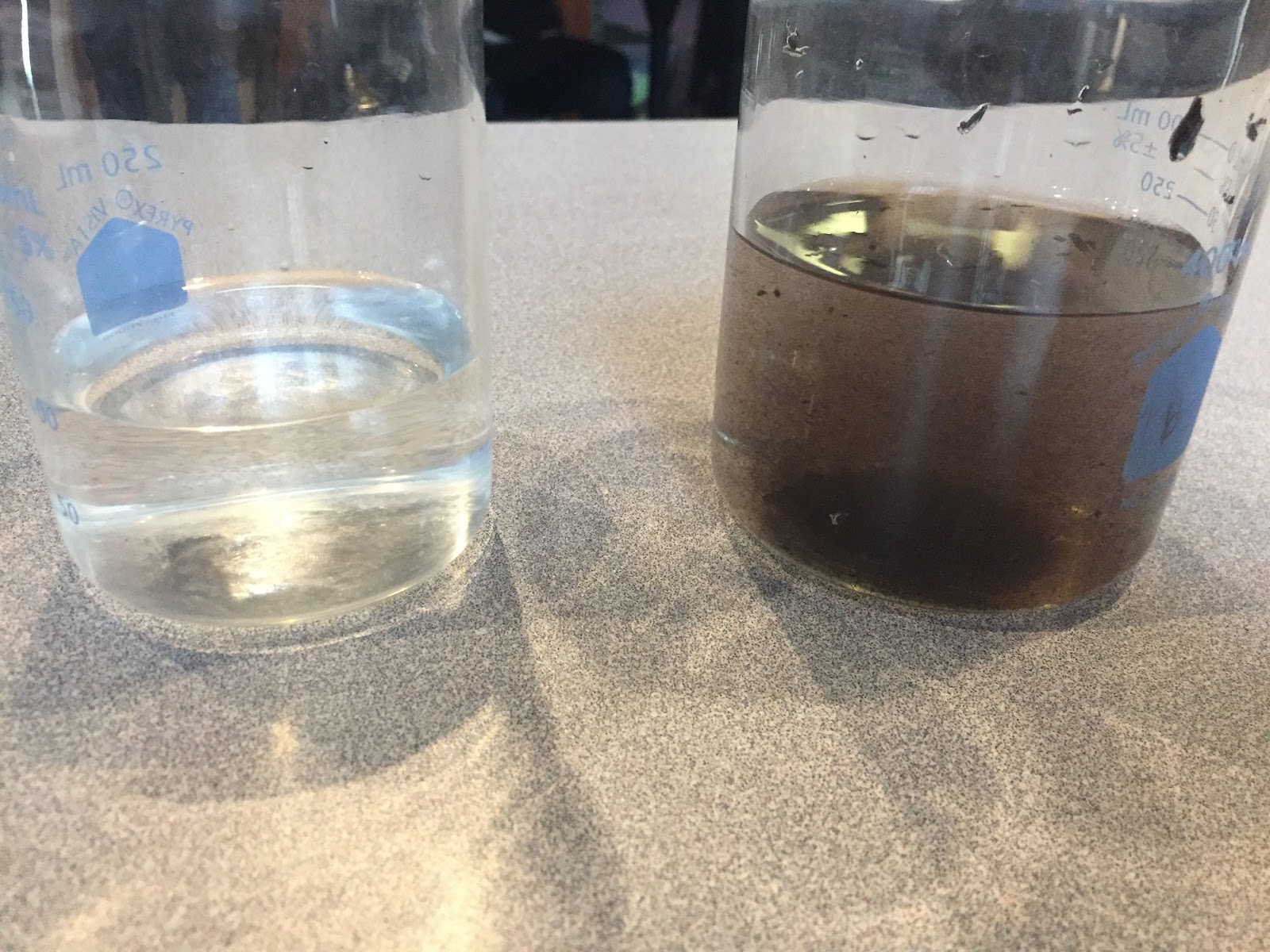 |
TN (2017) Before (right) and After (left)
|
Smells like a playground/gardenSmells clean/no smell
Looks dirty/like mud
Looks clear
Tastes clean not metallic, very pure and refreshing
pH: 5.4
pH 6.7
H+ 0.000003941
H+ 0.0000002
Both water samples fall closer to the neutral pH level (7) which means that both might have been safer to drink although I did not drink the water before filtration.

These are the pH levels converted to H+
3.9 x 10^-6 (before) 2 x 10^-6 (after) the difference between those levels is 19.9. I used the equation 10^-5.4/ 10^-6.7.
I can conclude that the mix of charcoal sand and gravel will clean water to a point that it is safe to drink. My hypothesis was proven correct. All of the dirt was removed from the water and after it went through the filter it was completely clear and smelled like nothing. It took me a couple of times to get the water filter to work, the first time I put too much sand in and all of the water got trapped and nothing came out. The next time I made it I used activated carbon instead of charcoal but the water still came out cloudy. My final product added multiple layers of activated charcoal and sand then added aquarium core which came out with the best, clearest result.
Citations
The King Random “DIY: Make Swamp Water Drinkable” Youtube Jul 6 2017 accessed Oct 9 2017
Looks dirty/like mud
Looks clear
Tastes clean not metallic, very pure and refreshing
pH: 5.4
pH 6.7
H+ 0.000003941
H+ 0.0000002
Both water samples fall closer to the neutral pH level (7) which means that both might have been safer to drink although I did not drink the water before filtration.
These are the pH levels converted to H+
3.9 x 10^-6 (before) 2 x 10^-6 (after) the difference between those levels is 19.9. I used the equation 10^-5.4/ 10^-6.7.
I can conclude that the mix of charcoal sand and gravel will clean water to a point that it is safe to drink. My hypothesis was proven correct. All of the dirt was removed from the water and after it went through the filter it was completely clear and smelled like nothing. It took me a couple of times to get the water filter to work, the first time I put too much sand in and all of the water got trapped and nothing came out. The next time I made it I used activated carbon instead of charcoal but the water still came out cloudy. My final product added multiple layers of activated charcoal and sand then added aquarium core which came out with the best, clearest result.
Citations
The King Random “DIY: Make Swamp Water Drinkable” Youtube Jul 6 2017 accessed Oct 9 2017
Friday, September 22, 2017
Is Water a Luxury?
In H2O we've learned about the importance and rarity of water. In this unit (71%) we discussed potable water and the percentage of it in the world. At our Field Experience my partner and I carried 3 gallons in total from the Chicago River back to GCE which was about 0.2 miles away. This action project shows the difference between the average American, Peruvian, and my water usage.
 TN (2017) Is Water a Luxury?
I never thought that by the end of one unit my perspective of water would change so drastically. The hardest part for me was organizing my poster so it flowed well. Over all, I am proud of how my action project turned out. I am more conscious of how much water is being trashed in my household and with a water crisis going on in a city only 271 miles away from where I live it's important that I don't take it for granted.
Only 2.5% of the world water is potable what are you going to do to make sure it lasts.
Water Tips
CITATIONS
Relentless (2016) American Flag USA Flag= Symbol
Cburnet (2007) Water drop
Huhsunqu (2006) Flag of Peru

One of the first things we did was calculate our water usage. It turns out that my calculated water usage (82 gallons) is lower than the average Americans water usage but higher than the average Peruvian. Hygiene was the highest consume of water for me, I assume it's because I do a lot for my skin care and it takes a lot to wash my hair because it's so curly. It shocked me that the average water consumption for Peru was so low. It seems impossible to me to only use 43 gallons of water everyday after calculating my own water usage. In our Field Experience we simulated what it would be like to carry water everyday from a water source. I brought in an empty kitty litter container and my partner brought in milk jugs all together it took us 8 min to carry 3 gallons of water which is only 3 percent of my daily water usage and 6 percent of Peru's . While I was carrying the water it only felt that it was only getting heavier, my arms started to hurt and I was extremely thirsty. It was easier for me because I was able to switch off with my friend and take breaks if I was by myself I would have probably taken longer.
Only 2.5% of the world water is potable what are you going to do to make sure it lasts.
Water Tips
- Turn off water while brushing teeth or washing hair
- Check leaky toilets and fix them immediately
- Water plants with unfinished water bottles
- Only run the dish washer a clothes washer when they are full
CITATIONS
Relentless (2016) American Flag USA Flag= Symbol
Cburnet (2007) Water drop
Huhsunqu (2006) Flag of Peru
Monday, September 11, 2017
H2O: A Long Walk to Water and A World Without Water Connection
Over the Summer, we were assigned to read the book A Long Walk To Water by Linda Sue Park and watch a documentary called a world without water. The video below is my review/connection of both to each other, the course I'm taking H2O, and to GCE.
Subscribe to:
Posts (Atom)
-
 Tambako the Jaguar, " Two Lemurs... " 2011 Hello and welcome to the first STEAM action project of my sophomore year! In this u...
-
In unit 3 of our Water class we learned about climate change and its effect on our world. We had 3 guests come in. Something that intrigued ...
-
For our first humanities course, we learned about the 17 SDGs and how they are centered on Maslow's hierarchy of needs. I am very passio...